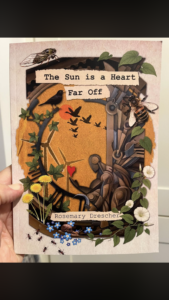
Rosemary Drescher takes us on a journey from the Sun where nature flourishes in all its glory. It has a remarkable tactile sensory ability in enabling the reader to immerse themselves in the natural world on a profound level. There is an organic quality in the poems that actively connect land and sea. It is direct and as definite as nature itself. The illustrations add a poignant addition.
A labyrinth of nurture includes many animals and insects that are used in a rich and busy trail with the atmosphere enhanced with dramatic bursts of weather from the four UK seasons. From seed to flower, tree and herb, the narrative takes the reader through unseen detail to feel the growth on the page. The reader can also appreciate the poet’s love for nature in the busy urban spaces lived. For example in the poem ‘Another Person’ set on a train full of people, a certain distance is created with ‘From the midst of human beings I recognise another person’. Or in the poem ‘Parting at the Shard’ which juxtaposes the high rise shard with other gentle but busy poems about nature. In this poem human nature and sentiment are brought in. There is also a busy poem at a train station but we are quickly brought back to the bee’s pollen and the snail. Even cigarette smoke is likened to a gardender’s back! And then to the potting shed. There is a feeling of growth throughout ‘The Sun is a Heart Far Off’. In the poem ‘Little Sycamores’ there is no containing the evolution of nature! The love of nature of the poet is further understood with poems on climate change.
The poet’s familiar surroundings of Morecambe Bay are also explored in ‘Time and Tide Bell’, Morecambe Bay and in St Peter’s Chapel, Heysham. We also read about life in a boarding school and travelling home to different places around the world as well as later family life.